
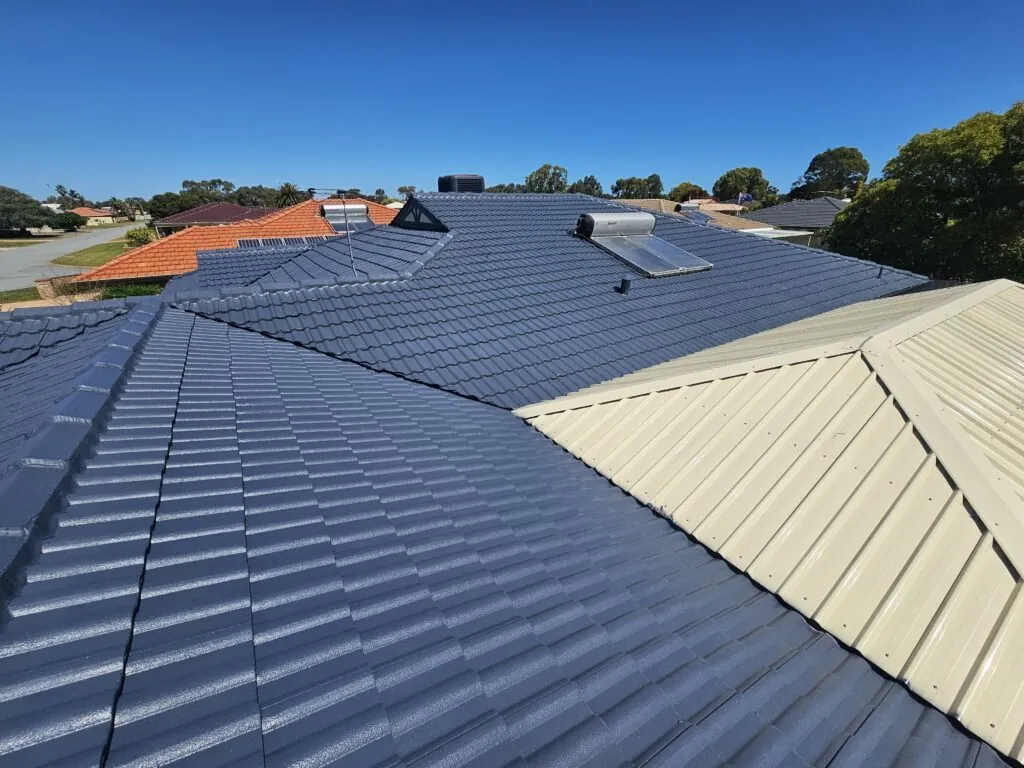
Ascot is really two suburbs stacked on top of each other. There is the older brick and tile around the racecourse, and there is everything built out at Ascot Waters since the nineties. They are at completely different stages of their life and they need completely different jobs. We work out which one you have got before anybody quotes you.
The older streets near the racecourse are mostly brick and tile from the fifties through the seventies. On a roof that age the tiles themselves are usually still fine, because concrete and terracotta tiles outlive the things holding them down. What has gone is the mortar. The ridge capping has lost its pointing, the bedding underneath has cracked, and the caps move when you walk them. That is restoration territory, and it is the job the whole trade is built around.
Out at Ascot Waters and the newer infill, you are looking at roofs twenty to thirty years old. Those are rarely ready for a full restoration and we will say so. What they usually want is a proper clean, the pointing checked and touched up where it has started to go, and the valleys cleared. Quoting a full restoration on a roof like that is the easiest way in the world to overcharge somebody, and we are not going to do it.
Plenty of roofs we look at do not need the big job. If yours is one of them you get told that on the day, in writing, along with roughly how many years you have got before it does.
Ascot sits low on the Swan flats, and the streets closest to the water hold moisture in a way the higher eastern suburbs do not. On a south facing pitch that never gets a proper hit of sun, that shows up as moss and lichen years earlier than it would a few kilometres inland. It looks alarming and it is usually not structural.
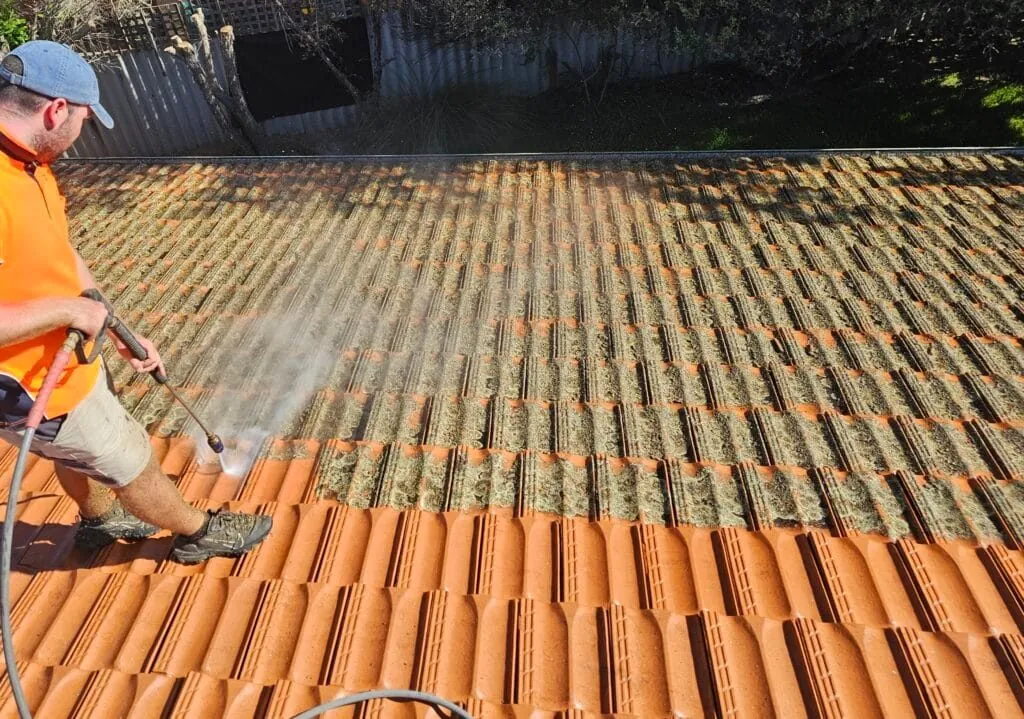
The mistake is treating it as a restoration trigger on its own. Moss on a sound roof is a cleaning and sealing job. Moss on a roof whose pointing has already gone is a different conversation, because now water is getting somewhere it should not be. Same green stain, two different answers, and the only way to tell them apart is to get up there and look.
High pressure clean so the surface is actually visible. You cannot assess a roof you cannot see, and half the "damage" under moss turns out to be staining.
Ridge caps and pointing, cap by cap. This is the difference between a clean and a restoration and it takes ten minutes to establish.
Leaf litter in a valley on a low lying block holds water against the tiles permanently. It is the cheapest fix on this list and the most commonly skipped.
Only after those three do we say clean, repair or restore. In that order, with a number against each, on paper.
None of this replaces getting on the roof, but you can get most of the way from the ground with a decent look and a bit of honesty about the age of the house.
Pre 1980 and the pointing is almost certainly past its life whether or not anything is leaking. Post 1995 and it is far more likely to be a clean and a check.
Stand at the corner of the block and sight along the ridge. If the caps sit unevenly, or you can see gaps and crumbling mortar between them, the pointing has gone.
Sand and grit in the gutter is tile surface that used to be on the roof. A lot of it means the tiles have lost their coating and are drinking water.
Green or black growth on the south side only, with a clean north side, points at moisture rather than age. That is usually the cheaper end.
If two or more of those point at the pointing, it is worth having somebody up there. If none of them do, it is probably a clean, and we will happily tell you that and take the smaller job.
Ascot is not priced differently to anywhere else in Perth. What changes the number is which of the two jobs your roof is asking for. A full restoration on a three to four bedroom home runs $4,000 to $9,000. Ridge capping re-bedded and re-pointed on its own runs $1,200 to $3,000. A full high pressure clean runs $800 to $2,000. On the newer roofs out at Ascot Waters the answer is very often the bottom of that list, not the top.
Tiles, ridge capping, valleys and flashings, prep and sealer, coating, and the guarantee. Six lines you can hold next to anybody else's quote and compare properly. Full detail is in the cost guide.
Leaks, broken tiles, lifted caps and storm damage, found on the roof before anything is priced.
Replacement and repair. On a low lying block a blocked downpipe does damage faster than you would think.
High pressure clean. On the shaded river side of Ascot this is often the whole job.
Prep, sealer and coating done as named stages, not as one word on a quote.
For the roofs that are genuinely past restoring. We will tell you when that is the case.
"Mati and Ryan did a fantastic job and I can't believe how wonderful my roof looks! Tiles replaced, ridge capping repaired, painted and sealed, plus extra jobs done at the last minute!"
"Awesome job. Great at communications and really looks after his clients. Rare to find people who will do their job and provide proper support these days. Killi is definitely one of them."
"Mati and his team did a great job on my roof. He was so busy but promised he would have it done by Christmas and he did. So happy with his work. Would highly recommend this company."
Probably not yet. At twenty five years the tiles are usually sound and the pointing is often still doing its job. What that age of roof normally wants is a clean, the valleys cleared and the ridge capping checked, with any failed sections re-pointed. That is a much smaller number than a restoration. We will look and tell you honestly which side of the line you are on.
Usually yes. Age on its own is not what rules a roof out. Concrete and terracotta tiles routinely outlast the mortar holding the ridge caps down, so a fifty year old roof with sound tiles and failed pointing is exactly what a restoration is for. What rules a roof out is the structure underneath, or tiles that have gone so porous they are drinking water. We check both before quoting.
On its own, a clean. Ascot sits low near the river and the south facing pitches hold damp, so growth appears earlier here than further inland. Moss on a roof with sound pointing is a cleaning and sealing job. Moss on a roof whose pointing has already failed is a restoration conversation, because water is now getting underneath. The green looks identical either way, which is why we get up there rather than guess from the driveway.
A clean is generally a day. Ridge capping re-bedded and re-pointed is usually two. A full restoration on a standard three to four bedroom home runs three to five working days depending on the weather and how much tile replacement is involved. You get the expected run of days on the quote, not a vague answer on the phone.
No. The assessment and the work both happen on the roof and we do not need access inside unless you have an active leak we are tracing. Plenty of people are at work the whole time. You get the written quote either way, and nothing gets started until you have read it and said yes.
We work right across the Perth metro, north and south of the river. These suburbs have a page of their own: Applecross, Ascot, Baldivis, Canning Vale, Joondalup, Midland, South Perth, Wanneroo. If yours is not listed we almost certainly still get there, so ask and we will tell you straight away.
Tell us roughly how old the house is and what you have noticed. We come out, get on the roof and tell you which of the two jobs it actually needs. The look costs nothing.